Comfort zone challenge

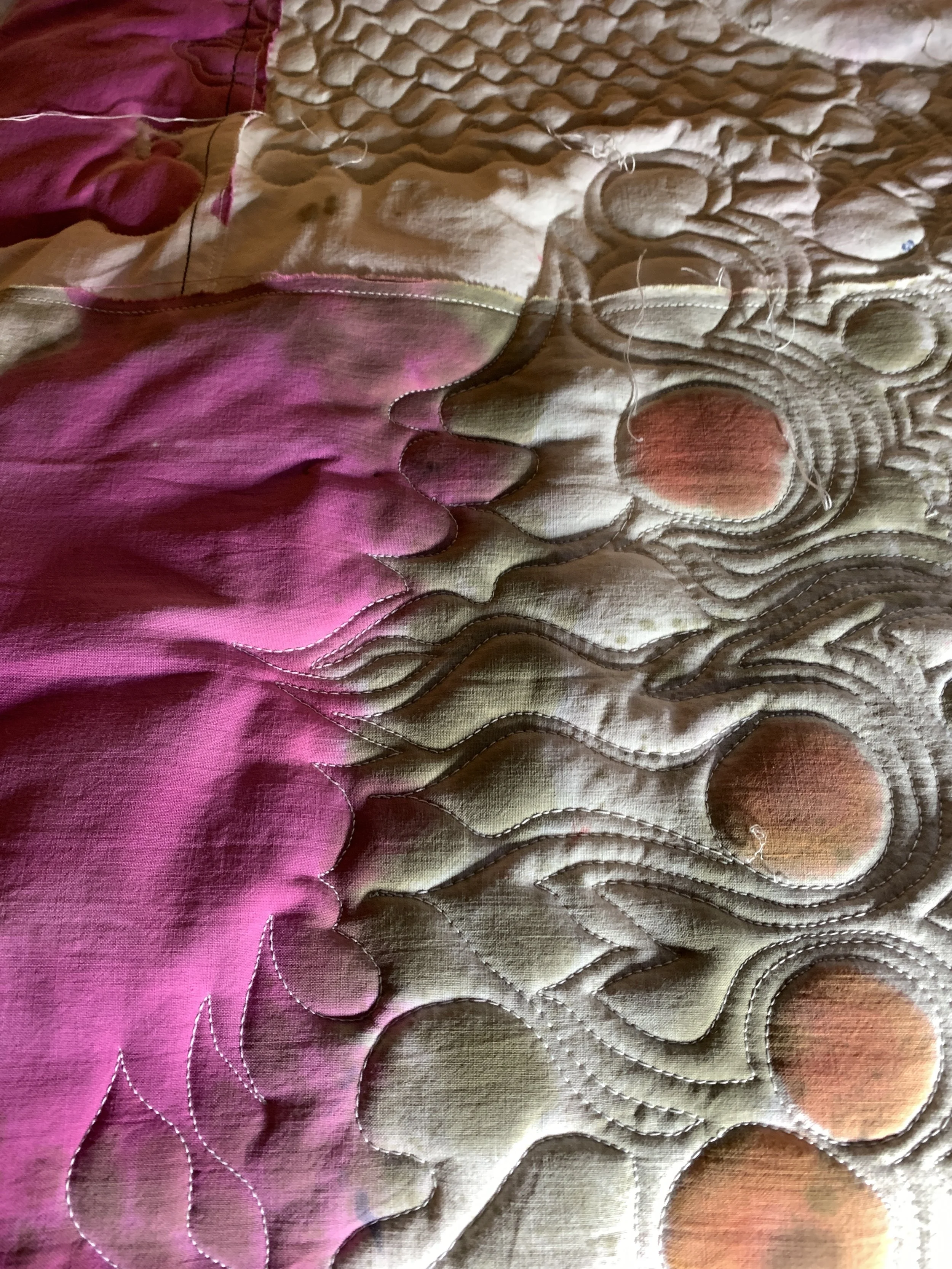
Steamroller. Yup. Steamroller. That's what we will use to print fabric in October. The next five weeks will find me at the Five in One Social Club workshop carving a 40" x 96" woodcut that we will ink and roll over. With a steamroller. Forty by ninety-six, big enough to be used as a banner, a shroud or a toga. Or maybe a quilt. Or two.

I've always wanted to design large prints, but never had access to large presses. This will be the first time I will carve a woodcut. It's a comfort zone challenge. There's no telling how much joy or regret I will feel during this process. Start thinking big. Yup. Big. No little stitch details necessary. (Oh...OK...maybe after I get the fabric printed I could add little stitch details...watch this space).

And of course it will be fabric. My medium of choice. Cotton, stretched delicately over an inked board, coming alive with pressure. Lots of pressure, watch your fingers.

Not sure what I will name this piece. All I know right now is that I'll be carving out all of the white areas. Final print size: 40 x 96.

So, naturally, I think about cutting it up and stitching swathes of yardage.

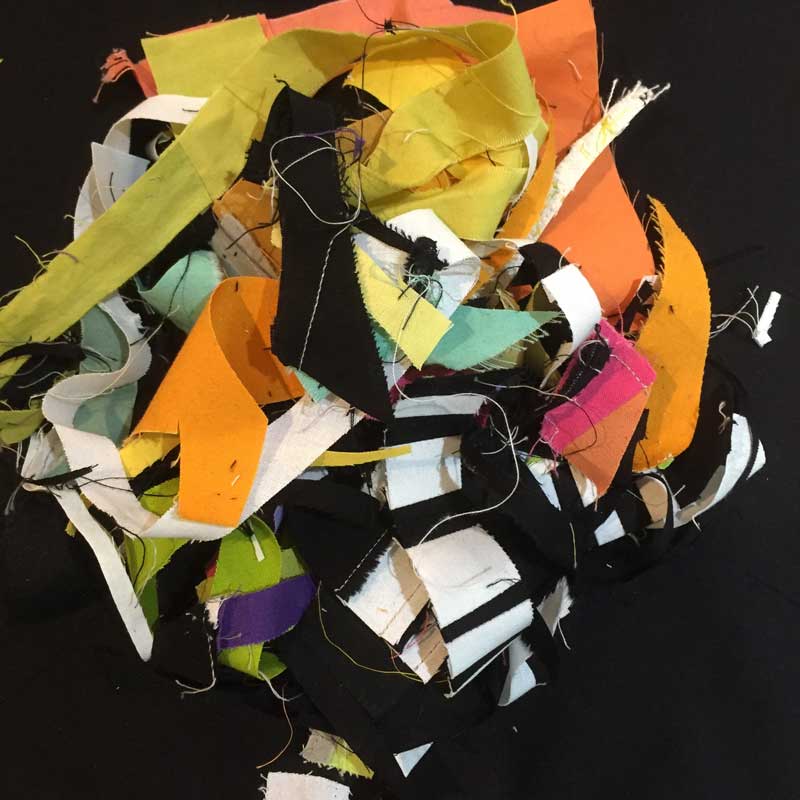
I could add batting and stitching to the print but if I cut it up I have some very interesting pieces of black and white fabric.

And then the decision making begins. Oh my!

It's probably a good thing that my sewing machine is in the shop for maintenance. Not sure how much distraction I need during this challenge.

Think big. Work big. Oh my.

As Jefferson Airplane says in their classic song, White Rabbit:

Remember what the dormouse said
Feed your head, feed your head
 

grids and webs

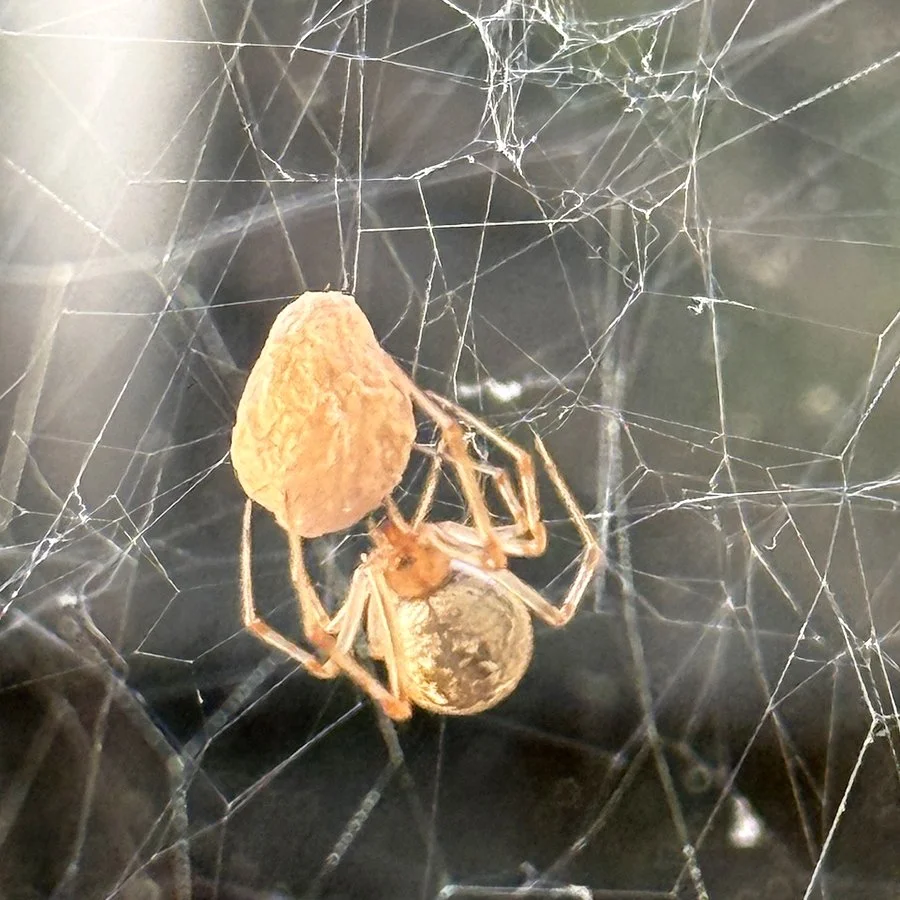
I woke up thinking about the difference between webs and grids. Webs reach, weave and beckon. Grids underpin, stabilize and neutralize. Webs are homes and traps. Grids are fences and containers. Webs spiral, grids measure cadence. Webs connect with tenuous intersections but also can withstand thunderstorms and errant wasps. Grids tie things together with a regular rhythm yet can be broken with a casual erasure of consistency. 

Webs can have enemies in them, grids can keep the lights on. Webs can be world-wide, grids map the lands and seas. Webs tangle, grids untangle. Grids are a human construct. Webs are a natural phenomenon. They are cousins in understanding where we fit.

Cracks, work in progress, Paula Kovarik

The news of Charlottesville and our president has shattered my sense of safety and calm. It may be why I keep cutting up pieces of fabric into shards and stitching them back together. Quilting this piece begins next week. I could stitch a grid onto it to find order. I could stitch a web of threads over it to hold it all together. Or I might cut it up some more and practice sewing it back together over and over again. Not sure where the thread will take me.

It's in our nature.

I've been thinking about dysfunction. Siblings, political parties, major corporations, government, non-profit agencies — they all experience a little wrack and ruin over time. Personality conflicts, power grabs, bullying, and just plain incompetence can splinter the foundation of any assemblage.

It's in our nature.

So how do we face and focus on mending? It's clear we all need the balm of empathy. We need to find common ground to forge compromise and progress.

Haywire, Paula Kovarik, 2017

We need to clear the air and listen. Speak truth to power and allow for differences.

Ladder to Elsewhere, Paula Kovarik, 2017

I say we act like crabgrass. Move with energy into the cracks. Sew up the middles so that the edges have a base to grow on.

Rough layout for Crabgrass, Paula Kovarik

Still looking

These tiles had one thing in common. Black thread on a neutral background.

I'm still thinking about how patterns emerge. And how our brains look for unifying elements to make sense of chaos. Quilts use repeat modules to create a whole from fragments. So, if I brought disparate elements together could I create a whole? Here's a few base thoughts:

  1. Regularity unifies.
  2. Grids are glue.
  3. Lines travel and connect.
  4. Connection = comprehension

So I took a few of the sample thread studies I have laying around and cut them into 2" squares. Assembling them randomly on a background substrate created a tile-like pattern that I emphasized with a grid that holds them together.

Then I started looking for connections. These small tiles really have little in common— just some black thread on neutral fabric. My eyes seemed to bounce around the assemblage, hip hopping to find similarities. So I added a line mimicking the hip-hop journey my eyes were taking. 

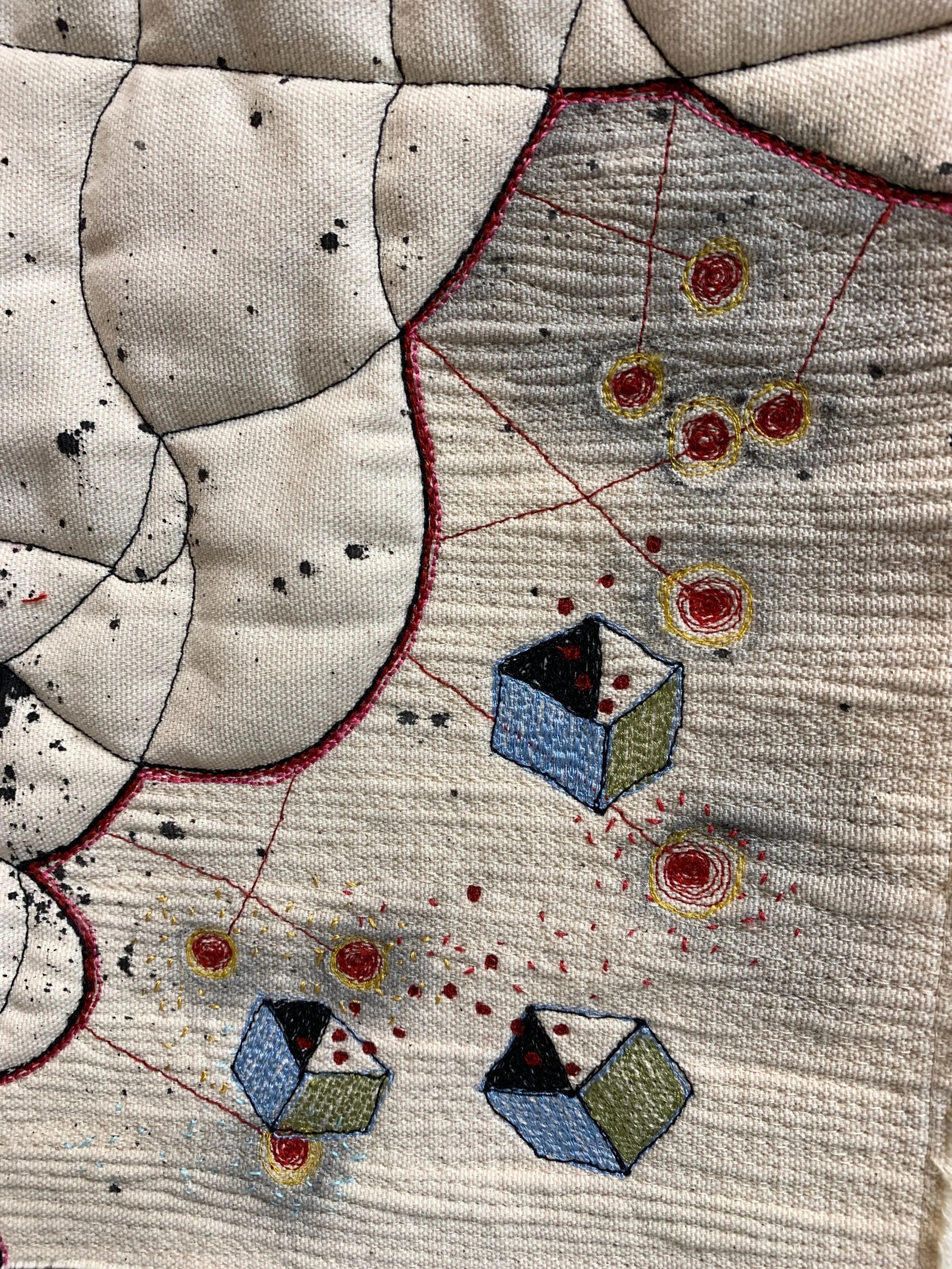
Adding denser fill stitching at the intersections of the connecting line and patterned tile added a sense of rhythm to the piece.

Adding hand-stitched details adds action and brings the tiles together in small areas.

Then I turned the piece to the back to see what was happening with my random connections.

The picture on the left is the front of the assemblage. The one on the right shows the stitching I added to the piece. I love the raw quality of those marks. And, I had no idea that I had formed a face in profile when I was working from the front.

Here's another comparison. The left side is dense with stitching and linework that is beginning to represent my idea of complexity and chaos. The back shows a simpler yet texturally consistent stitching that appeals to me. There's a sense of space on that side that brings more focus on the character of the lines.

I'm not sure how much farther I want to take this piece. I love the complexity that is beginning to show up with the layered stitching. And I like the back of the piece. I'll have to study it a while.


Looking for the pattern that connects

Moving through a shattering period of tenuous health concerns and re-defining what is important in life, I was frozen in my work.

So I grabbed a bunch of scraps and started putting them together. That process gives me a sense of accomplishment at the end of the day regardless of outcome.

My thoughts were on how disruption forces contemplation. How pieces have to be sorted and put back together. How mending provides silence for thought.

Someday I'd like to do an installation of all the scraps I have in this studio. They tell so many stories about the effort and work.

Someday I'd like to do an installation of all the scraps I have in this studio. They tell so many stories about the effort and work.

As I was putting together random scraps of fabric they were added to my design wall in a rough estimation of a body. I wanted to create a figure filled with anxiety, confusion and isolation. Lonely—moving toward an uncertain horizon.

The piece morphed many times.

At one point it was so tall I had to extend my table.

Loved the action of this one but didn't like the way the figures interacted. Negative space is clunky.

I am always tempted by the backs of these assemblages. I am certain that I will end up turning one of them around in the future.

This solitary figure started my brain working toward a story.

The figure morphed into a tipsy unbalanced figure being watched by a secondary figure.

Experimenting with background and foreground. Still too disparate right to left. The figure disappeared.

The final composition prior to beginning the stitching had a flow to it that leads my eye around the piece.

The resulting composition gave me a number of opportunities for thread stories. Movement, itchiness, hidden messages. Playing with the tension on my thread and using a black thread on top with a variegated thread below gave medotted line that comes in and out of focus.

I see the figure as a witness to the chaos, looking for the pattern that connects.

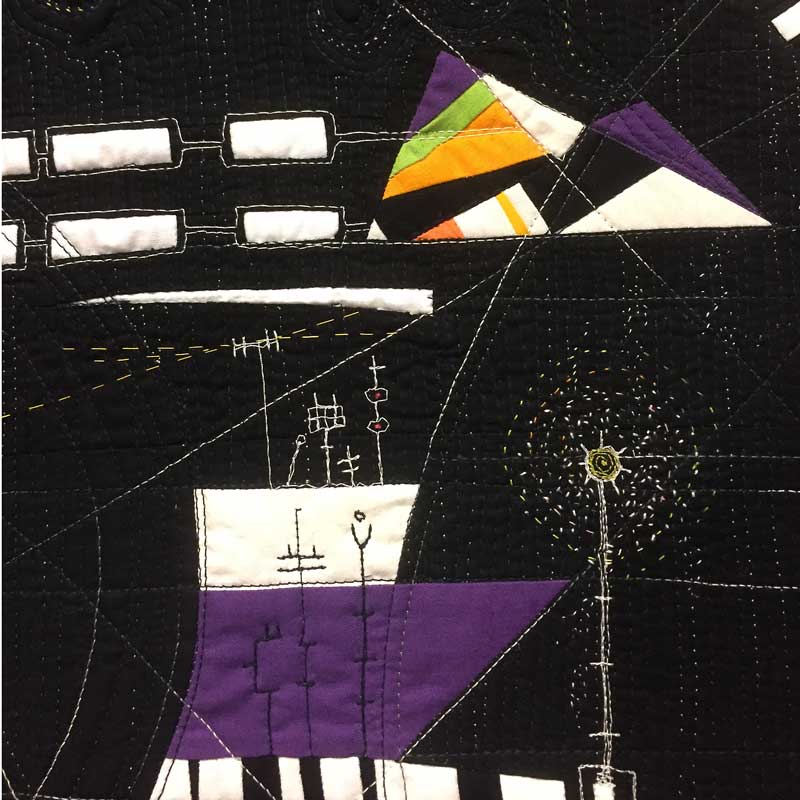
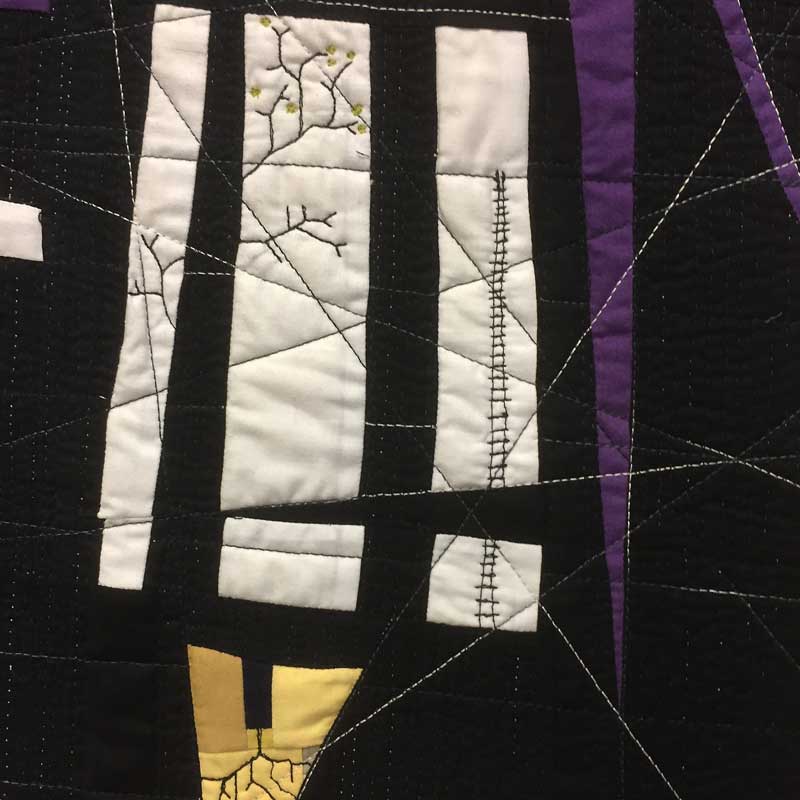
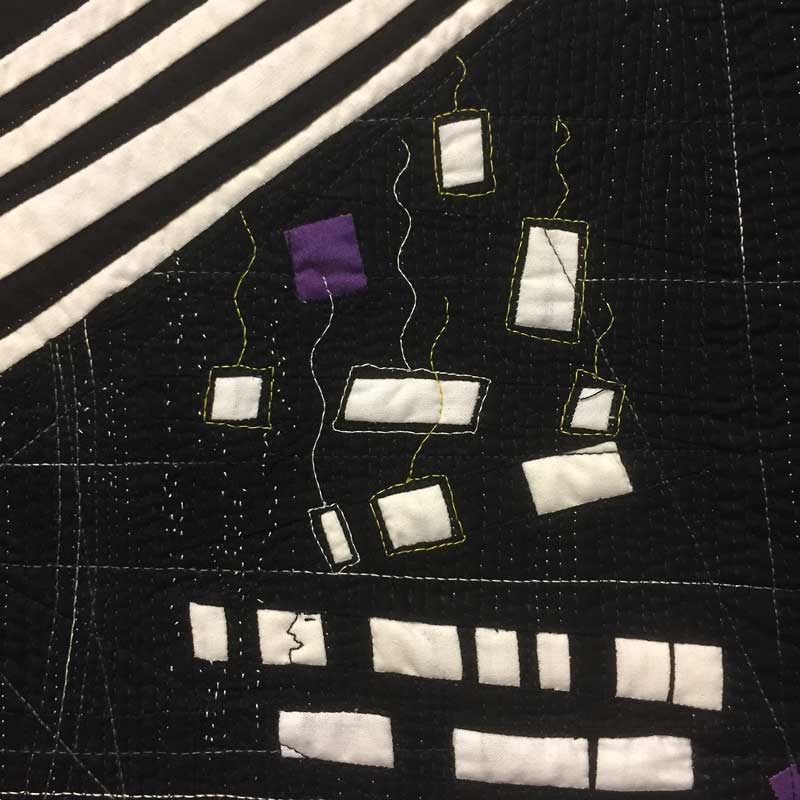
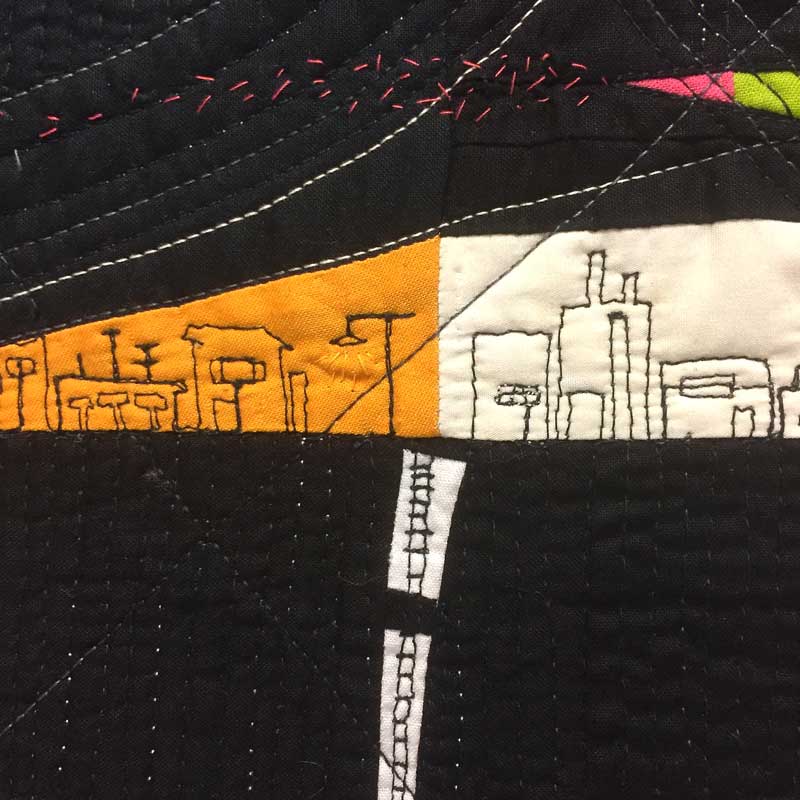
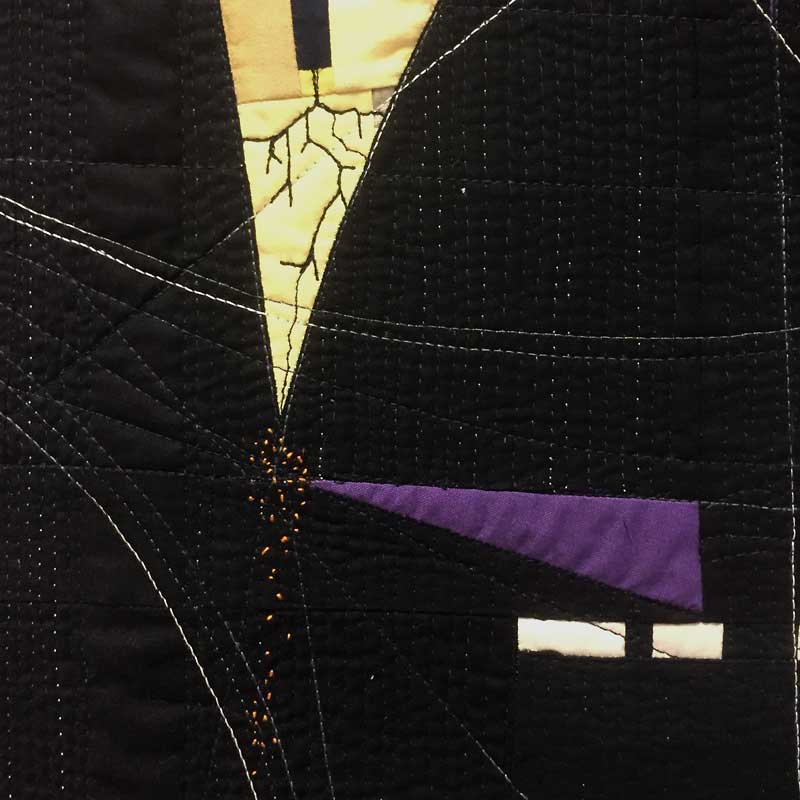
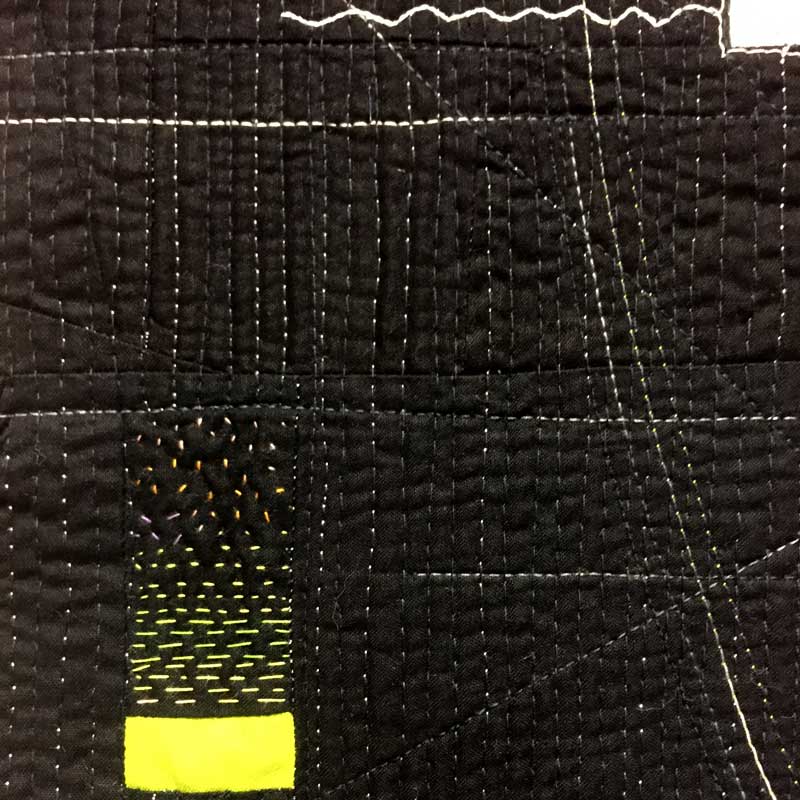
Below are some of the details.

Almost done. Looking for the pattern that connects. Paula Kovarik 2017